
October 28, 2026 · Dennis Miguel
2027 Marketing Plan Checklist for Small Businesses
Build your 2027 marketing plan in an afternoon: review 2026, set one goal, do the math, pick your channels and set a budget.
Most small businesses go into January with a vague goal (“grow”) and no plan for how. Then the first busy month hits and marketing stops. A one-page plan built in Q4 fixes that. This marketing plan checklist walks you through building your 2027 plan in an afternoon: look back at what worked, set one goal, do the math, pick your channels and set a budget.
Key takeaways
- Start with last year’s numbers, not ideas. Know where your customers actually came from.
- Set one revenue goal, then work backward to how many leads and visitors you need.
- Pick two or three channels you can run well, not seven you’ll abandon by March.
- Gartner’s 2026 survey puts marketing budgets at 7.8% of revenue for large companies. Use it as a sanity check, not a rule.
- Plan for AI search: 45% of consumers now use AI tools to find local businesses.
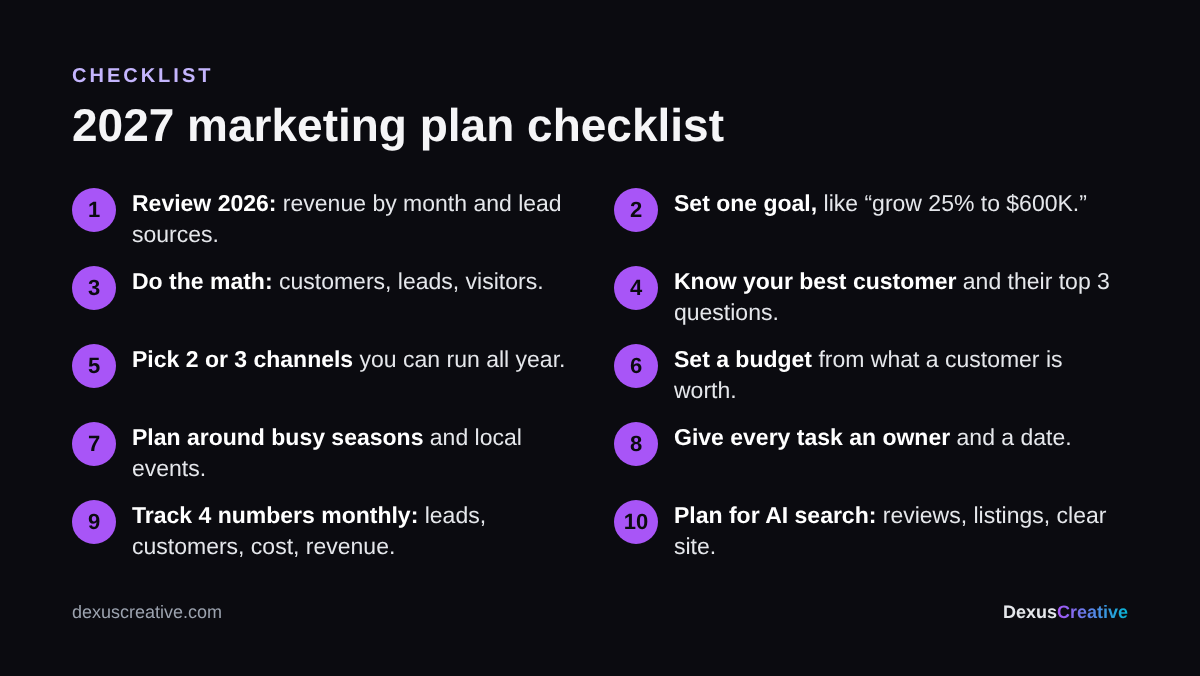
1. Look back at 2026
- Revenue by month. Note your slow and busy seasons. Plan to market before the busy months, not during them.
- Where customers came from. Referrals, Google, social, ads, repeat customers. If you don’t know, start asking every new customer this year.
- What you spent and what it returned. For each channel, roughly how much money and time went in, and how many customers came out.
- Your best customers. Who spent the most, came back most and referred others? You want more of them.
2. Set one goal
Pick one number for the year: revenue, new customers or average order value. “Grow 25% to $600K” is a goal. “Get more followers” is not.
3. Do the math
Work backward from the goal so you know what marketing has to deliver.
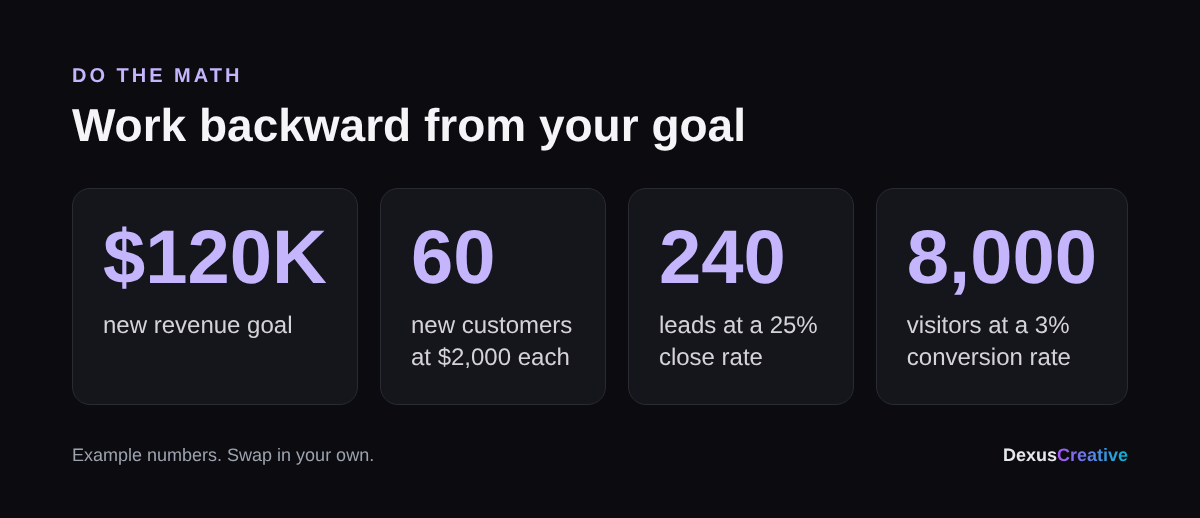
- New revenue needed ÷ average customer value = new customers needed
- New customers ÷ your close rate = leads needed
- Leads ÷ your website or ad conversion rate = visitors needed
Now you can judge any channel by one question: can it realistically bring that many leads?
4. Know your customer and your offer
- Write one sentence on who you serve best, and the problem they hire you to solve.
- List the three questions they ask before buying. Each one is a blog post, a video and an FAQ.
- Make sure your offer is clear: what they get, what it costs (or a range), and how to start.
5. Pick two or three channels
- Google Business Profile and reviews: essential for any local business. See our Google Business Profile optimization checklist.
- Website and SEO: a site that answers customer questions keeps bringing traffic for years.
- Social media and short video: best for awareness and trust. Start with the platform your customers use most.
- Email: the cheapest way to bring past customers back.
- Paid ads: fastest to turn on, and they stop the day you stop paying. Use them to test offers and fill slow seasons.
- AI search: AI assistants now recommend businesses directly. BrightLocal found 45% of consumers use AI tools to find local businesses, up from 6% a year earlier. See how to get your business recommended by AI.
6. Set a budget
Gartner’s 2026 CMO Spend Survey found marketing budgets average 7.8% of company revenue. That sample is mostly companies above $1 billion in revenue, so treat it as a reference point. For a small business, a simpler approach works:
- Decide what a new customer is worth to you, and what you can afford to pay to win one.
- Multiply by the number of new customers you need. That’s your working budget.
- Keep 10% to 20% aside to test something new each quarter.
- Count your time too. Ten hours a month of your own time has a real cost.
7. Build a simple calendar
- Mark your busy seasons, holidays and local events (in San Diego: Small Business Saturday, summer tourist season, back to school).
- Plan one main campaign per quarter and a steady weekly rhythm in between.
- Give every task an owner and a date. A plan with no owner doesn’t happen.
8. Measure every month
- Set up Google Analytics key events for calls, forms and bookings.
- Tag links with UTMs so you know which channel each lead came from.
- Spend 30 minutes at the start of each month on four numbers: leads, customers, cost per customer and revenue. Adjust next month’s plan from there.
About Dexus Creative
Dexus Creative is a San Diego marketing agency for local businesses with high-value customers, like dental practices, med spas, roofers and other home services. We’re a small team that does the whole job in-house, so you deal with one partner instead of a videographer, an ads freelancer and an SEO vendor who never talk to each other.
- Short-form video, shot and edited by us. We film at your business, so every ad and post shows your real team and your real work.
- Paid ads on Meta, Google and TikTok. We use that video as ad creative and test it fast.
- Local SEO and AI visibility. Google Business Profile, reviews, service pages, and the listings ChatGPT and Gemini read when they recommend businesses.
- Landing pages and tracking built for each campaign, so every lead is counted.
How we work: we test with a small budget, measure cost per lead and per new customer, and only scale what pays for itself. You get a clear report every month. We also offer a retainer-plus-equity model for growth-stage businesses, so we win when you do.
Results we’ve published: 40% year-over-year growth for Excelarace, a first product run that sold out in under two months for BoBlocks, and 900+ pre-launch users for CareTabs.
Want to see where you stand first? Run the Free Local SEO Audit or the LLM Visibility Audit. Both are free. Or get in touch with Dexus Creative to talk through your goals.
Sources
- Gartner, 2026 CMO Spend Survey (401 marketing leaders)
- BrightLocal, Local Consumer Review Survey 2026: AI recommendations
Frequently Asked Questions
Last year's results by channel, one clear goal, the math for how many leads and visitors you need, your ideal customer and offer, two or three channels, a budget, a simple calendar with owners, and a monthly review of leads, customers, cost per customer and revenue.
There's no single rule. Gartner's 2026 survey puts budgets at 7.8% of revenue, but that's mostly very large companies. A practical approach is to decide what you can pay to win a customer and multiply by the number of new customers you need.
Two or three you can run consistently. A local business usually starts with its Google Business Profile and reviews, its website, and one social platform its customers use.
In Q4, ideally October or November, so campaigns are ready before January and before your busiest season.