October 22, 2026 · Dennis Miguel
Does AI Recommend Your Brand? How B2B Startups Get Named by ChatGPT, Gemini and Perplexity
Half of B2B software buyers now start research in an AI chatbot. Here's what ChatGPT, Gemini and Perplexity cite when they recommend vendors, and how startups get on the shortlist.
A founder asks ChatGPT, “What’s the best CRM for a 10-person agency?” A few seconds later they have a shortlist of three or four tools, a line about each, and a suggestion for where to start. They haven’t opened Google, visited a vendor site or talked to sales. If your product isn’t in that answer, you weren’t considered. This guide covers how to get your brand recommended by ChatGPT, Gemini, Perplexity and other AI assistants when B2B buyers ask for vendors, using research published in 2025 and 2026.
Key takeaways
- 51% of B2B software buyers now start research in an AI chatbot more often than in Google, up from 29% a year earlier (G2, 2026).
- 69% of buyers chose a different vendor than planned because of AI guidance, and a third bought from a vendor they’d never heard of.
- For software recommendations, ChatGPT mostly cites vendors’ own comparison pages and small niche sites, not analysts or big review platforms.
- Being mentioned across the web, especially on YouTube, tracks with AI visibility far more than backlinks or publishing more pages.
- That’s good news for startups: you don’t need Gartner coverage to get named.
Why it matters: the shortlist now forms inside the answer
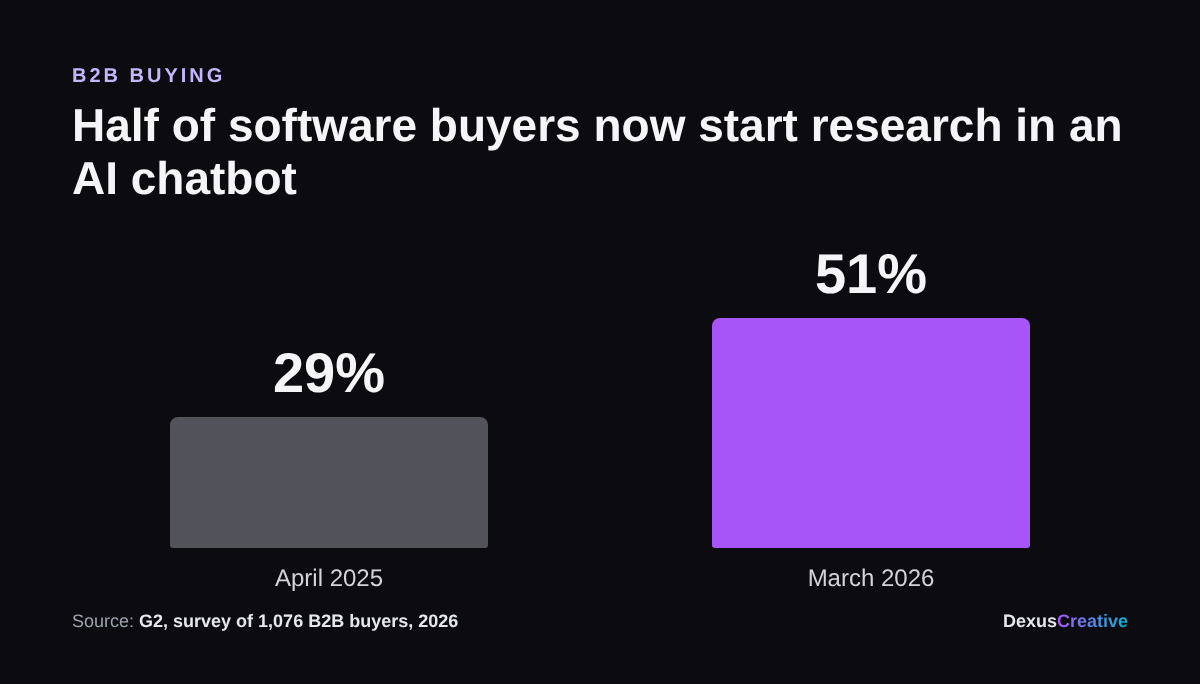
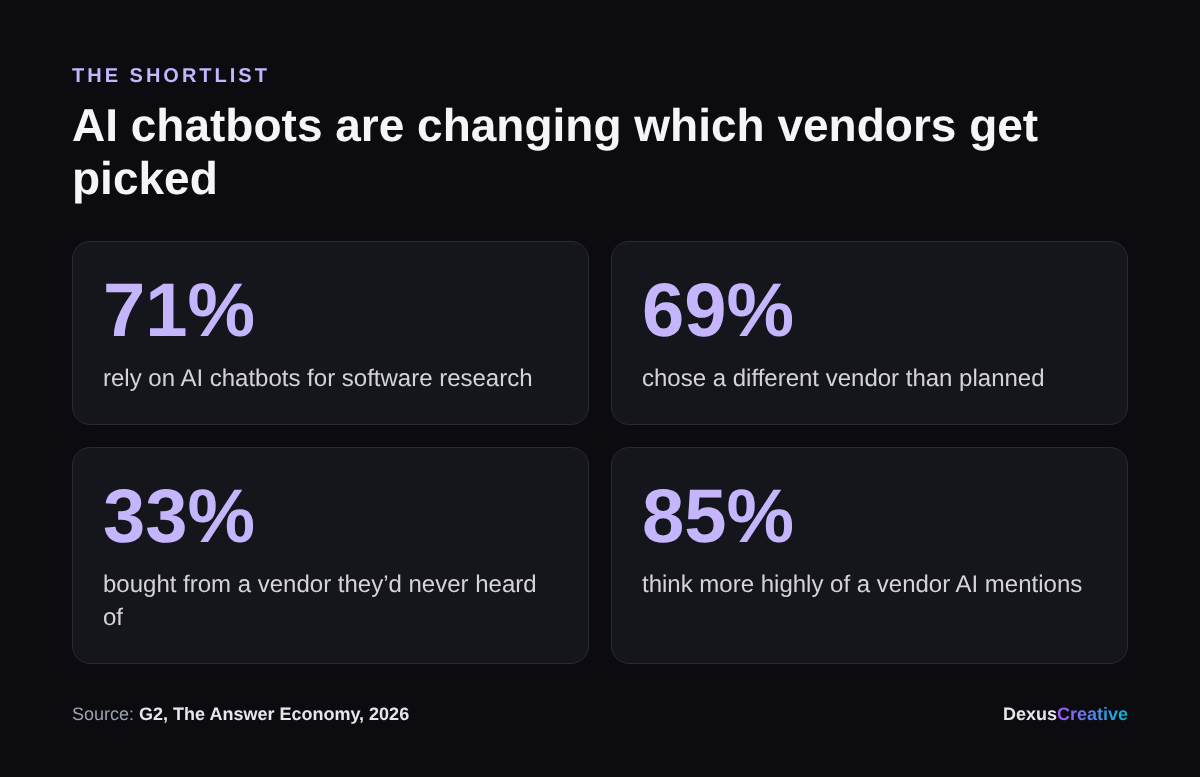
G2 surveyed 1,076 B2B software buyers in March 2026. The shift in one year is hard to ignore:
- 51% now begin software research with an AI chatbot more often than with Google, up from 29% in April 2025.
- 71% rely on AI chatbots for software research.
- 69% chose a different vendor than they first planned based on AI chatbot guidance.
- 33% bought from a vendor they weren’t familiar with before.
- 85% think more highly of a vendor when an AI chatbot mentions it in a recommendation.
- ChatGPT is the most used, at 63% of AI software research.
Clicks are shrinking at the same time. Pew Research found that when Google showed an AI summary, people clicked a regular result on just 8% of visits, against 15% when there was no summary. The buyer gets the answer without visiting your site, so being named in the answer is the new first impression.
Does AI recommend your brand? Why startups have a real shot
In traditional search, big established brands usually win. AI search is more open, at least for now.
- One in three buyers in G2’s survey bought from a vendor they had never heard of. AI is putting unknown companies on shortlists.
- Ahrefs studied 75,000 brands and found ChatGPT’s mentions track weakly with classic authority metrics like Domain Rating (0.266 correlation). Google’s AI Mode leans more toward established brands.
- In DerivateX’s study of 40 software categories, a young product-management startup’s blog earned more ChatGPT citations than Gartner, Forbes or Reuters.
The catch: AI assistants mostly agree with each other on who to name. Ahrefs found a 0.779 overlap between the brands ChatGPT, AI Mode and AI Overviews mention. Once a competitor owns your category’s answer, it tends to own it everywhere. Getting in early matters.
Where AI gets its software recommendations
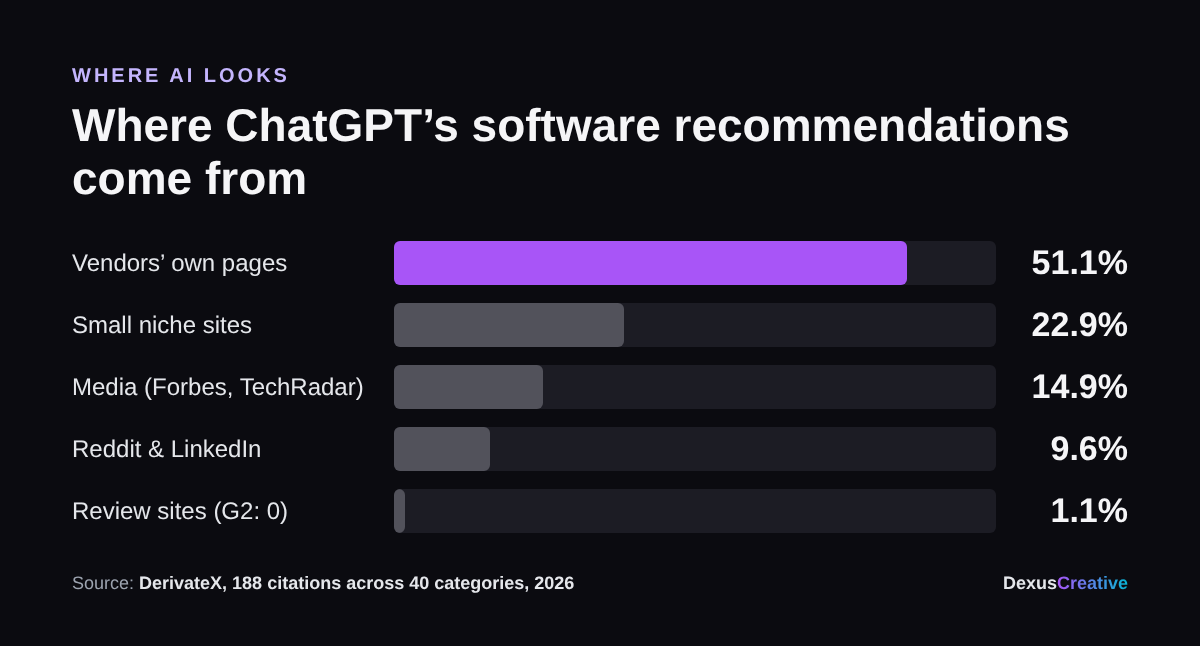
DerivateX asked ChatGPT (with web search) one buyer-intent question in each of 40 B2B software categories, then classified all 188 cited sources. Here’s where its recommendations came from:
- 51% from vendors’ own content, mostly “best tools for X” comparison posts that include the vendor itself
- 23% from small, independent niche sites
- 15% from recognized media like TechRadar and Forbes
- 10% from communities like Reddit and LinkedIn
- 1% from review sites. G2 and Capterra got zero citations.
Often a single well-structured comparison post supplied three or four of the brands in an answer.
That doesn’t mean reviews are useless. In G2’s survey, 45% of buyers said review-site citations are what make them trust an AI recommendation, and 64% say they often run into inaccurate AI recommendations. AI gets you onto the shortlist. Reviews help you survive the buyer’s fact-check.
What makes AI mention a brand
Ahrefs’ 75,000-brand study is the clearest look at which signals line up with AI visibility across ChatGPT, AI Mode and AI Overviews:
- YouTube mentions had the strongest correlation of any factor (about 0.74).
- Branded web mentions, people writing about you anywhere online, were close behind (0.66 to 0.71).
- Number of pages on your site barely mattered (about 0.19). Publishing more doesn’t get you named.
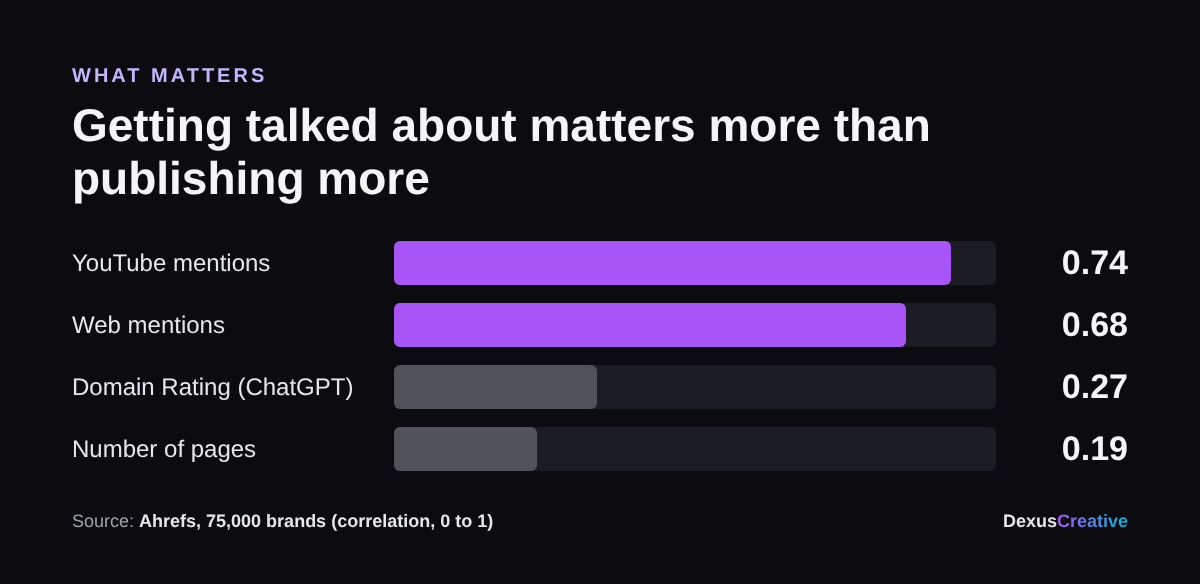
Correlation isn’t proof, but the pattern is consistent: AI repeats what the rest of the internet says about you. Your own site has to state it clearly, and other people have to say it too.
How to get your brand recommended by ChatGPT and other AI assistants
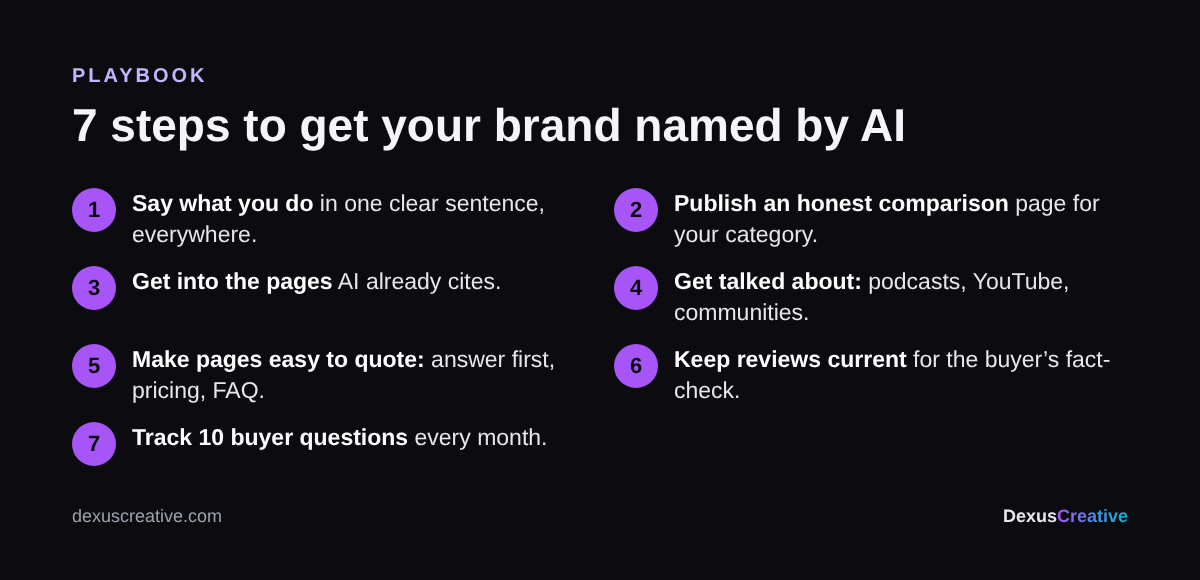
1. Write one clear sentence about what you do
“Project management software for creative agencies with 5 to 50 people” beats “the future of work.” Use the same description on your homepage, LinkedIn, Crunchbase, your G2 profile and your founder bios. AI can only recommend you for a use case it can connect to you.
2. Publish an honest comparison page for your category
Vendor-written comparison posts are the single biggest source ChatGPT cites for software. Write the “best [category] tools for [audience]” page yourself. Include real competitors, say who each one fits best, and be specific about where you win and where you don’t. A biased page gets ignored by buyers even if AI quotes it.
3. Get into the pages AI already cites
Ask Perplexity or ChatGPT your category’s buying questions and look at the sources. Those comparison posts, newsletters and niche directories are your PR list. Reach out to the authors with a demo, a free account or data they can use. It’s often a small blog, not a major publication.
4. Get talked about, not just linked
Mentions matter more than links. Go on podcasts and YouTube channels your buyers watch, post useful founder content on LinkedIn, answer questions in the Reddit and Slack communities where your buyers hang out, and share original data journalists can quote.
5. Make your pages easy to quote
Put the direct answer first: what it is, who it’s for, what it costs. Add clear pricing, use-case pages, integrations, an FAQ and structured data. Check that your robots.txt doesn’t block AI crawlers like GPTBot, PerplexityBot and ClaudeBot.
6. Keep reviews current for the fact-check
Buyers check AI answers against reviews. Ask happy customers to review you on G2 or Capterra, reply to every review, and keep your profile matching your site.
7. Track it every month
Rankings don’t capture this. Write down the 10 questions your buyers actually ask, run them in ChatGPT, Gemini, Perplexity, Claude and Copilot every month, and track how often you’re named and who’s named instead.
How to find gaps in your AI visibility
Start with questions like these, filled in for your category:
- “What’s the best [category] for [audience]?”
- “[Competitor] alternatives for a small team”
- “[Your brand] vs [competitor]”
- “Is [your brand] good for [use case]?”
- “How much does [category] software cost?”
If you’re missing from the first two, you have a discovery gap: work on steps 2 to 4. If you show up but the details are wrong, like old pricing or a feature you dropped, you have an accuracy gap: fix your site, profiles and the pages being cited.
See where you stand
Our Free LLM Visibility Audit checks whether your website gives AI assistants what they need to understand and cite you: crawler access, structured data, content structure and brand signals. It takes about a minute and there’s no signup.
For local businesses, see our companion guide, How to Get Your Business Recommended by AI.
About Dexus Creative
Dexus Creative is a San Diego marketing agency for startups and growth-stage businesses. We’re a small team that does the whole job in-house, so you deal with one partner instead of a videographer, an ads freelancer and an SEO vendor who never talk to each other.
- Short-form video, shot and edited by us. We film at your office and with your product, so every ad and post shows your real team and your real work.
- Paid ads on Meta, Google and TikTok. We use that video as ad creative and test it fast.
- Local SEO and AI visibility. Google Business Profile, reviews, service pages, and the listings ChatGPT and Gemini read when they recommend businesses.
- Landing pages and tracking built for each campaign, so every lead is counted.
How we work: we test with a small budget, measure cost per lead and per new customer, and only scale what pays for itself. You get a clear report every month. We work on a retainer-plus-equity model (2–15%), so we win when you do.
Results we’ve published: 40% year-over-year growth for Excelarace, a first product run that sold out in under two months for BoBlocks, and 900+ pre-launch users for CareTabs.
Questions about your AI visibility? Get in touch with Dexus Creative.
Sources
- G2, The Answer Economy: How AI Search Is Rewiring B2B Software Buying (survey of 1,076 B2B buyers, March 2026)
- DerivateX, The Authority Inversion: How ChatGPT Really Decides Which Software to Recommend (June 2026)
- Ahrefs, Top Brand Visibility Factors in ChatGPT, AI Mode, and AI Overviews (75K brands) (December 2025)
- Pew Research Center, analysis of 68,879 Google searches with and without AI summaries (2025)
Frequently Asked Questions
Describe what you do and who it's for in one clear sentence and use it everywhere, publish an honest comparison page for your category, get featured in the comparison posts and niche sites ChatGPT already cites, earn mentions on podcasts, YouTube and communities, make your pages easy to quote, and keep reviews current. Then track your buyers' top questions every month.
Yes. In G2's March 2026 survey of 1,076 B2B software buyers, 51% said they start software research in an AI chatbot more often than in Google, and 69% chose a different vendor than planned based on AI guidance.
Rarely, according to a 2026 DerivateX study of 40 software categories. Half of ChatGPT's cited sources were vendors' own comparison pages and about a quarter were small niche sites; G2 and Capterra received no citations. Reviews still matter, because buyers use them to check AI recommendations.
Yes. Ahrefs found ChatGPT's brand mentions correlate only weakly with authority metrics like Domain Rating, and a third of buyers in G2's survey bought from a vendor they had never heard of. Clear positioning, comparison content and mentions across the web matter more than size.
List the 10 questions your buyers ask, such as 'best [category] for [audience]' and '[competitor] alternatives', and run them in ChatGPT, Gemini, Perplexity, Claude and Copilot each month. Track how often you're named, who is named instead, and whether the details about you are accurate.